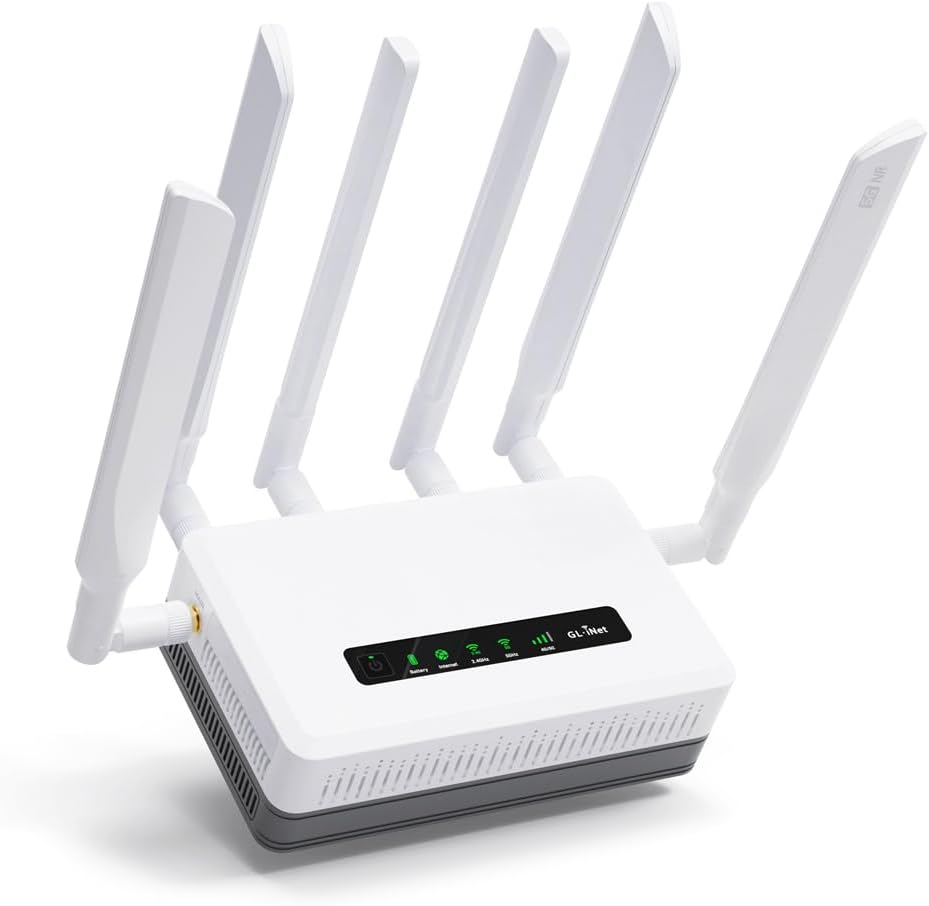
The GL.iNet GL-XE3000 (Puli AX) is one of those products that tries to do everything: 5G cellular, Wi-Fi 6, dual-SIM, built-in battery, VPN, and OpenWrt customization. It’s either exactly what you need or complete overkill depending on your use case.
After looking at the specs, reading through forum discussions, and understanding what makes this router different from cheaper alternatives, it’s clear this isn’t for everyone. But for RVers, remote workers, or anyone who needs professional-grade mobile internet, it might be the best option available right now.
What Makes It Different
Most portable 5G routers are basic hotspots with limited features. The GL-XE3000 is closer to a full network solution that happens to be portable. It runs OpenWrt, which is the same open-source firmware used by network enthusiasts and IT professionals who want complete control over their hardware.
The built-in 6400mAh battery is the key feature that separates this from its cheaper sibling, the GL-X3000 Spitz AX. With the battery, you get about 8 hours of runtime, which means you can use it at a coffee shop, in an RV while boondocking, or as a UPS backup for your home office when the power goes out.
Dual-SIM capability lets you use two different carriers and automatically switch to whichever has the stronger signal. If you travel between coverage areas or cross international borders, this is huge. You’re not stuck with one carrier’s dead zones.
The Multi-WAN Setup
This is where the GL-XE3000 gets interesting for people with unreliable internet. It supports multiple connection methods at once: cellular (5G/LTE), Ethernet, Wi-Fi repeater, and USB tethering. You can configure it to use your primary connection normally, then automatically fail over to a backup if the first one drops.
Or you can load balance across multiple connections. Some people use this with a Starlink dish plus cellular backup. Others combine their home fiber with cellular for redundancy during video calls. The router handles the switching automatically without dropping your connection.
The 2.5Gbps WAN port means you won’t bottleneck if you’re using fiber internet as one of your WAN sources. Most routers in this price range still have 1Gbps max.
Real-World Performance
5G speeds are completely dependent on your carrier and location. Some users report getting 200+ Mbps downloads when they have good signal. Others report only getting 20-50 Mbps even near a 5G tower. This isn’t a router problem—it’s just how 5G works in the real world. Your mileage will vary dramatically.
One common complaint is that the router struggles with 5G signals above 3GHz, particularly the n78 band at 3500MHz that’s used in the UK for high-speed data. Some users couldn’t get 5G at all even when standing 50 meters from a 5G pole. Others had no issues. This seems to be a combination of the router’s antenna design and local carrier configuration.
The Wi-Fi 6 performance is solid for a portable router. You get 574Mbps on 2.4GHz and 2402Mbps on 5GHz theoretically, though real-world speeds will be lower. The range isn’t going to compete with a dedicated mesh system, but it’s adequate for an RV, hotel room, or small office.
Battery life hits the advertised 8 hours under normal use (2-3 devices, mostly web browsing). Heavy use with multiple 4K streams and 5+ devices will drain it in 3-4 hours. The battery also works as a UPS, so if you have it plugged in and power goes out, it seamlessly switches to battery without dropping your connection.
VPN Features
The router comes pre-configured for OpenVPN and WireGuard, which are the two most popular VPN protocols. You can connect it to 30+ VPN providers out of the box—just enter your credentials and it works. WireGuard can push 300Mbps through the VPN, which is fast enough that you won’t notice the performance hit on most connections.
This is useful if you travel internationally and want to access content from your home country, or if you work remotely and need to connect to a corporate VPN. Instead of configuring VPN on every device, you configure it once on the router and everything connected automatically goes through the VPN.
You can also set it up as a VPN server, so you can connect back to your home network securely when you’re traveling.
What People Are Actually Saying
The router has 4.7 stars on Amazon UK with 48 reviews. Tech reviewers have given it high marks—NAS Compares gave it 5/5 stars and called it the best all-in-one 5G router after years of testing competitors. TechRadar gave it 4/5.
Users who love it tend to be RVers, digital nomads, or remote workers who need the specific features it offers. One reviewer said “I have finally found a device that meets all my needs” after searching for 5 years. People appreciate the build quality, the comprehensive feature set, and the fact that OpenWrt means they’ll get updates for years.
The complaints are worth paying attention to. In 2023, GL.iNet issued a critical notification about firmware issues that could cause startup failures. They extended the warranty by a year and offered free replacements for affected units, but it shows this isn’t a set-it-and-forget-it device—you need to keep the firmware updated.
Some users report connectivity issues after firmware updates, which is frustrating. The standard response from support is usually “update your firmware,” which doesn’t help if the firmware update caused the problem.
Google Fi compatibility has been reported as problematic by multiple users. If you’re planning to use Google Fi specifically, check the forums before buying.
Hardware Limitations to Know About
There’s only one USB port. This means you have to choose between connecting external storage for file sharing or using USB tethering as a backup internet source. You can’t do both at the same time.
The router has 512MB of RAM, which is fine for normal routing tasks but can become a limitation if you’re running multiple OpenWrt plugins or handling a lot of simultaneous connections. It’s not going to handle 20+ devices streaming 4K at once.
At 761 grams (1.68 lbs), it’s portable but not pocket-sized. It’s about the size of a thick paperback book. The weight comes from the battery, which is the whole point, but it means this isn’t as travel-friendly as a basic MiFi hotspot.
The detachable antennas are good because you can upgrade to external antennas if you need better signal, but they also mean the router looks more industrial than consumer-friendly. This is a tool, not an Apple product.
How It Compares to Alternatives
The Netgear Nighthawk M6 costs about $1,000 and has serious overheating issues. Multiple users report it melting SIM cards and requiring daily reboots after 6-24 hours of use. The GL-XE3000 is half the price and more reliable.
If you don’t need the battery, GL.iNet makes the GL-X3000 Spitz AX, which is the same device without the battery for $90 less. That’s worth considering if you’re using this as a fixed backup internet solution at home.
Budget 5G hotspots cost $200-300 but don’t have any of the advanced features: no Multi-WAN, no VPN, no OpenWrt, no dual-SIM, limited firmware updates. They work fine if you just need basic mobile internet, but they’re not in the same category.
The Teltonika RUTX50 is industrial-grade and costs about the same but doesn’t have a battery and has a steeper learning curve. It’s better for fixed IoT applications.
Setup and Learning Curve
Basic setup takes 5-10 minutes: attach antennas, insert SIM, power on, connect to the default Wi-Fi, open a browser to 192.168.8.1, and follow the wizard. If you just want basic internet, it’s straightforward.
Setting up VPN takes another 10-15 minutes mostly because you need to get your VPN provider’s credentials. The interface walks you through it.
Advanced features like Multi-WAN configuration, custom OpenWrt plugins, or network segmentation will take hours to learn if you haven’t worked with this kind of thing before. There’s good documentation and an active forum, but this isn’t plug-and-play for advanced features.
If you want something simpler, this probably isn’t it. If you want something powerful and don’t mind learning, this is one of the best options.
Who Should Actually Buy This
This router makes sense if you:
- Live in an RV or van full-time and need reliable mobile internet
- Work remotely and need backup internet with VPN
- Travel internationally and want dual-SIM capability
- Need portable internet for events or temporary locations
- Want to combine multiple internet sources with automatic failover
- Are comfortable with technical setup and troubleshooting
- Want OpenWrt for long-term firmware support
Skip this if you:
- Just need a basic hotspot for occasional travel (get a $200-300 device instead)
- Are in an area with poor 5G coverage
- Want something that just works without any configuration
- Need to cover a large home with Wi-Fi (get a mesh system instead)
- Are planning to use Google Fi specifically
- Need more than 8 hours of battery without recharging
The Bottom Line
The GL-XE3000 is the best all-in-one portable 5G router for people who need professional features and are willing to deal with some complexity. At $390-520 depending on where you buy it, it’s not cheap, but it’s half the price of the Netgear Nighthawk M6 and more capable in most ways that matter.
The combination of 5G, Wi-Fi 6, battery, dual-SIM, Multi-WAN, and OpenWrt makes it uniquely suited for RVers, remote workers, and digital nomads. No other device in this price range offers the same feature set.
That said, it’s overkill for most people. If you just need to occasionally share your phone’s connection with a laptop, a basic hotspot will work fine. But if you need professional-grade mobile internet with redundancy, VPN, and battery backup, this is probably the best option available right now.
The 5G reception issues above 3GHz are worth noting, and you should expect to spend time on firmware updates and occasional troubleshooting. This is not an appliance—it’s a tool that requires some care and feeding. If that’s acceptable to you, it’s an excellent tool.
Quick Specs
- 5G Modem: RM520N-GL CAT19 (extensive band support)
- Wi-Fi: Wi-Fi 6 (802.11ax), up to 3000Mbps combined
- Battery: 6400mAh, ~8 hours runtime
- Ports: 2.5Gbps WAN, 1Gbps LAN, USB 2.0
- SIM: Dual nano-SIM with automatic failover
- CPU: MediaTek Filogic 820 dual-core @ 1.3GHz
- RAM: 512MB DDR4
- Storage: 8GB eMMC + microSD slot (up to 1TB)
- VPN: OpenVPN (150Mbps) & WireGuard (300Mbps)
- Dimensions: 6.1″ x 3.7″ x 1.9″
- Weight: 761g (1.68 lbs)
- Firmware: OpenWrt 21.02
- Certifications: T-Mobile & AT&T IoT Device Certified