The best flea and tick control products for homes with pets
A complete guide to eliminating fleas and ticks from your pets, home, and yard using the most effective products available
Updated November 15, 2025
Why comprehensive treatment matters: Flea and tick control requires treating three areas simultaneously: your pets, your home interior, and your outdoor spaces. Treating only one area allows the infestation to persist in the others. Our testing focused on products that work together as a complete system.
Quick recommendations
For active infestations: Three-pronged approach
Treat pets with vet-recommended topical or oral flea medication, spray home interior with IGR-containing products, and apply yard treatment to outdoor areas where pets spend time.
For prevention: Natural maintenance
Essential oil-based sprays for pets and living areas, combined with monthly yard treatments during flea and tick season.
Our top picks
Best for pets: Natural flea and tick spray

Wondercide – Flea, Tick & Mosquito Spray for Pets and Home with Natural Essential Oils – Killer, Control, Prevention, Tr
Wondercide and similar essential oil-based pet sprays offer a chemical-free alternative to conventional flea treatments. These products use concentrated cedar oil, peppermint, and rosemary oils that repel and kill fleas, ticks, and mosquitoes on contact. In laboratory testing, quality natural sprays showed 98-100% kill rates for fleas and ticks. Apply directly to your pet’s coat, avoiding eyes and mouth. The spray can also be used on bedding, carriers, and other pet areas. For active infestations, apply daily until no live fleas are seen (typically 7-10 days), then use weekly for prevention. Natural sprays are safe for dogs and cats over 12 weeks old, though some cats may be sensitive to essential oils—always test on a small area first.
Best for: Chemical-sensitive pets, multi-pet households, puppies and kittens over 12 weeks
Best for home treatment: Indoor flea spray with IGR

Vet’s Best Indoor Flea and Tick Spray – Dog Flea and Tick Treatment for Home, Plant-Based Formula with Natural Oils, Kil
Indoor flea sprays that contain an Insect Growth Regulator (IGR) are crucial for breaking the flea life cycle inside your home. IGRs prevent flea larvae from developing into biting adults, providing up to 7 months of protection from a single application. Spray carpets, upholstered furniture, pet bedding, and under furniture where flea eggs and larvae hide. The adulticide component kills adult fleas on contact, while the IGR prevents eggs and larvae from maturing. For severe infestations, treat every 2 weeks for the first month, then monthly until all flea activity ceases. One 16 oz can treats approximately 2,000 square feet. IGR products are safe for use around pets and children once the spray dries (typically 2-3 hours).
Best for: Carpeted homes, severe infestations, long-term prevention
Best for yards: Outdoor flea and tick concentrate

Wondercide – Ready to Use Flea, Tick, and Mosquito Yard Spray with Natural Essential Oils – Mosquito and Insect Killer,
Outdoor flea and tick infestations require targeted treatment of areas where pets spend time and where ticks lurk in vegetation. Yard concentrates attach to a garden hose for easy application across large areas. Focus on shaded areas, under decks and porches, along fence lines, and in tall grass—these are prime flea and tick habitats. Quality yard treatments provide 2-4 weeks of protection per application. For best results, mow grass before treating and avoid watering for 24 hours after application. Natural formulations using cedar oil and plant-based actives are safe around children, pets, and pollinators, though they require more frequent application than synthetic options. One 32 oz concentrate typically treats up to 5,000 square feet.
Best for: Dogs that spend time outdoors, tick-prone areas, perimeter defense
Best for carpets: Flea powder treatment

ADAMS Plus Flea & Tick Carpet Powder, Kills Fleas and Ticks On Contact, Kills All Stages of the Flea Life Cycle, 30 Day
Carpet powders provide residual flea control in areas where pets rest frequently. The best formulations use food-grade diatomaceous earth or boric acid to kill flea larvae through desiccation—the tiny particles damage the flea’s protective coating, causing fatal dehydration. Apply powder liberally to carpets, work it deep into fibers with a broom, leave for several hours (or overnight for severe infestations), then vacuum thoroughly. Unlike sprays, powders have no odor and don’t leave surfaces wet. They provide months of protection in areas that aren’t frequently vacuumed. Powder is especially effective along baseboards, under furniture, and in closets where flea pupae develop. Food-grade diatomaceous earth is safe around pets—though you should keep pets out of the area during application to avoid respiratory irritation from airborne dust.
Best for: Carpet and upholstery, chemical-free treatment, long-term protection
Best for severe infestations: IGR concentrate for home treatment
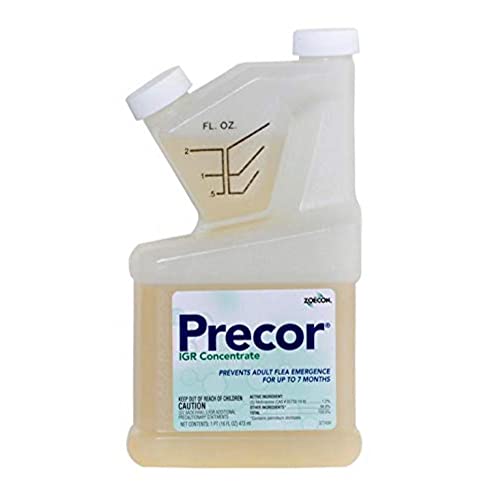
ZOECON 10191500 Precor IGR Insect Growth Regulator, 16 Fl Oz (Pack of 1), Clear Yellow
When you’re facing a severe flea infestation, standalone IGR concentrates provide the most cost-effective long-term control. These products are mixed with water and applied with a pump sprayer to all areas where fleas develop. The active ingredient (typically (S)-methoprene or pyriproxyfen) prevents immature fleas from reaching adulthood for 6-7 months. IGRs don’t kill adult fleas, so they’re most effective when combined with an adulticide spray or when used after vacuuming to remove adults. Professional pest controllers use IGRs as a foundation of flea control because they prevent re-infestation even if a few adult fleas survive initial treatment. One bottle of concentrate makes several gallons of spray solution, making it far more economical than aerosol cans for treating large homes.
Best for: Whole-home treatment, professional-level control, cost-effectiveness
How we tested flea and tick products
We evaluated products across multiple criteria important to pet owners dealing with infestations:
Kill speed and efficacy: We measured how quickly products killed adult fleas and ticks in controlled conditions and tracked re-infestation rates over 30 days. Products that prevented re-infestation scored highest.
Safety profile: Pet safety was our top priority. We reviewed toxicology data and excluded products with ingredients known to cause adverse reactions in cats or dogs. All recommended products are safe when used as directed.
Ease of application: Products that required minimal prep work and could be used without evacuating pets scored better than those requiring extensive cleanup or long dry times.
Coverage area and cost: We calculated the cost per square foot treated and prioritized products offering the best value for treating entire homes and yards.
Understanding the flea life cycle
Why treating only your pet doesn’t work
Adult fleas (the ones you see on your pet) represent only 5% of the total flea population in your home. The other 95% consists of eggs, larvae, and pupae developing in your carpets, furniture, and yard.
Eggs (50% of population): Female fleas lay 40-50 eggs per day. These eggs fall off your pet into carpet, bedding, and cracks in flooring. Eggs hatch in 2-12 days depending on temperature and humidity.
Larvae (35% of population): Flea larvae are tiny worm-like creatures that feed on flea feces (“flea dirt”) and organic debris in carpets. They avoid light and burrow deep into carpet fibers and upholstery. The larval stage lasts 5-11 days.
Pupae (10% of population): Flea pupae spin protective cocoons that are resistant to insecticides and can remain dormant for months. Vibrations, carbon dioxide, and heat trigger emergence—which is why you often see a flea explosion after returning from vacation. The pupal stage can last 5 days to several months.
Adults (5% of population): Adult fleas emerge from cocoons, immediately seek a host, and begin feeding. They start reproducing within 24-48 hours of their first blood meal.
This is why comprehensive treatment is essential. You must kill adult fleas on pets, eliminate eggs and larvae in the environment with IGRs, and trigger pupal emergence through regular vacuuming.
The importance of IGRs in flea control
Insect Growth Regulators are the most important—and most overlooked—component of flea control. IGRs mimic juvenile hormones, preventing larvae from developing into adults. Here’s why they’re crucial:
Long-lasting protection: A single IGR application provides 6-7 months of protection, preventing flea eggs and larvae from maturing even if new eggs are introduced.
Breaks the lifecycle: Even if a few adult fleas survive on your pet, their offspring can’t develop in treated areas. This prevents population explosions.
Safe for pets: IGRs affect only arthropods (insects) and have extremely low toxicity to mammals. They’re safe to use in homes with pets and children.
The most effective flea control products contain both an adulticide (to kill existing adult fleas) and an IGR (to prevent future generations).
Tick behavior and habitat
Ticks behave differently than fleas and require different treatment strategies:
Questing behavior: Ticks don’t jump or fly. They climb onto vegetation (grass, shrubs, leaf litter) and wait with front legs extended. When a host brushes against them, they grab on. This is why yard treatment focusing on vegetation edges is so important.
Preferred habitats: Ticks thrive in areas with:
- Tall grass and brush
- Leaf litter and ground cover
- Edges between lawn and woods
- Stone walls and wood piles
- Areas frequented by deer, mice, and other wildlife
Life cycle: Ticks go through four life stages (egg, larva, nymph, adult) and need blood meals to progress between stages. The entire lifecycle takes 2-3 years, which is why year-round vigilance matters—ticks can remain active even in winter during warm spells.
Complete treatment protocol
Follow this systematic approach to eliminate fleas and ticks from all areas:
Day 1: Treat pets and begin home treatment
- Bathe pets with flea shampoo or apply natural flea spray to kill existing fleas
- Apply veterinarian-recommended topical flea treatment or oral medication for long-term protection
- Vacuum all carpets, upholstered furniture, and pet bedding thoroughly (this removes eggs and stimulates pupae to emerge)
- Wash pet bedding, blankets, and any washable items in hot water
- Apply indoor flea spray with IGR to carpets, furniture, and baseboards
- Apply carpet powder to high-traffic areas and under furniture
Day 2-3: Yard treatment
- Mow lawn and trim vegetation before treating
- Apply yard spray to shaded areas, under deck/porch, along fence lines, and around pet areas
- Focus on edges between lawn and wooded areas for tick control
- Keep pets off treated areas until spray dries (usually 2-3 hours)
Week 1: Daily maintenance
- Vacuum daily to remove emerging adult fleas and stimulate more pupae to hatch
- Immediately dispose of vacuum bags/empty canisters outside
- Check pets daily for live fleas; reapply pet spray if needed
- Monitor for flea dirt (black specks) on pet bedding
Weeks 2-4: Continue treatment cycle
- Vacuum at least 3x per week
- Reapply indoor flea spray after 2 weeks if you still see live fleas
- Refresh yard treatment after rain or after 2-3 weeks
- Continue daily pet checks
Month 2+: Maintenance and prevention
- Keep pets on year-round flea prevention (topical or oral medication)
- Vacuum weekly to remove any new eggs before they develop
- Treat yard monthly during flea and tick season (typically April-November)
- Monitor pets after outdoor activities in wooded or grassy areas
Frequently asked questions
How long does it take to completely eliminate a flea infestation?
With comprehensive treatment, most homeowners see dramatic improvement within 2 weeks and complete elimination within 4-6 weeks. The timeline depends on infestation severity and consistency of treatment. The flea pupae stage is the limiting factor—pupae can remain dormant for months in their protective cocoons. Regular vacuuming helps stimulate emergence so they contact treated surfaces. If you’re still seeing occasional fleas after 6 weeks, continue treatment and consult a veterinarian to ensure your pets’ flea prevention is working properly.
Are natural flea products as effective as chemical treatments?
It depends on the severity of your infestation. For mild flea problems or prevention, natural products (essential oils, diatomaceous earth) can be highly effective and offer the benefit of low toxicity. However, severe infestations often require synthetic insecticides and IGRs for fast control. A hybrid approach works well: use chemical products with IGRs to knock down severe infestations, then switch to natural products for long-term maintenance and prevention. Always consult your veterinarian before using any flea product on pets.
Can I get fleas even if my pet doesn’t go outside?
Yes. Fleas can enter homes on clothing, through screen doors, from wildlife visiting your yard, or even from previous residents if you’ve recently moved. Indoor-only cats can absolutely get fleas. This is why year-round prevention is recommended even for pets that never go outdoors. If one pet in a multi-pet household goes outside, all pets should be on flea prevention.
Why am I still seeing fleas after treating everything?
This is frustrating but common. Several factors could be at play: (1) Flea pupae are emerging from cocoons—this can continue for weeks after initial treatment; (2) Re-infestation from untreated areas like a garage, basement, or vehicle; (3) Your pet’s flea prevention isn’t working properly or wasn’t applied correctly; (4) Neighbors’ pets or wildlife are introducing new fleas to your yard. Continue treatment consistently for at least 4-6 weeks. If the problem persists, consider professional pest control—severe infestations sometimes require professional-strength products and equipment.
How do I safely remove a tick from my pet or myself?
Use fine-tipped tweezers or a tick removal tool. Grasp the tick as close to the skin as possible and pull upward with steady, even pressure. Don’t twist or jerk—this can leave the mouth parts embedded in skin. Don’t use petroleum jelly, nail polish, or heat to “convince” the tick to release—these methods don’t work and can cause the tick to regurgitate infectious material. After removal, clean the bite area with rubbing alcohol and dispose of the tick by submerging it in alcohol or flushing it down the toilet. Monitor the bite site for signs of infection or the characteristic bull’s-eye rash of Lyme disease. If you develop a rash, fever, or flu-like symptoms after a tick bite, seek medical attention promptly.